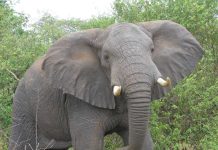
Many trees depend on the elephants’ digestive system for their seeds to be effectively propagated and if elephants become extinct, such trees would be prone to extinction. When the forest elephants eat the fruits of certain trees, they break the dormancy of the seeds and when they are excreted, the dispersed seeds germinate and sprout from the dung, giving hope for to combat climate change.
These are some of the revelations made on Monday by conservation experts at one of their community sensitisation programmes on the need to protect elephants in what is left of their natural home range in Nigeria.
The experts, from the Nigerian Conservation Foundation’s Forest Elephant Initiative and Rufford Foundation’s Elephant Conservation and Awareness Project, pointed out that the animals’ intelligence enables them to remember previous encounters with humans and to determine a course of action.
Speaking at Atikiriji Odo, a community in the boundary area of Omo Forest, Ogun State, Dr. Tajudeen Amusa, from the Department of Forest Resources Management, University of Ilorin, helped the community to appreciate the importance of the forest, the role of wildlife, especially forest elephants in maintaining the health of forest and how to live in peaceful coexistence with nature.
Dr. Amusa who has studied elephants throughout Nigeria for more than seven years highlighted the consequences of encroaching into the elephants’ territories, reminding the community that it is a criminal offence to kill elephants since they are protected by both local and international laws.
“The forest elephant is vulnerable to extinction and so, it is hard to kill it and escape dire consequences and punishment from the government,” he said.
He added that planting red pepper around their crops will help protect it from raiding by elephants.
Responding, Baale Atikiriji Odo, Afisu Busari, the Community leader thanked the experts for the initiative. He expressed appreciation to the team for travelling through difficult terrain to reach them with the crucial information and urged them to keep the good work up. The outreach was supported by Nigeria Conservation Foundation (NCF), Wild Planet Trust, Elephant Crisis Fund, Rufford Foundation among others.
According to recent estimates, there are less than 1000 individuals elephants of two different species — the forest elephant and the savannah elephants — in Nigeria. About 350 savannah elephants reside in the Yankari Game Reserve, while a viable population of less than 100 forest elephants reside in Omo Forest Reserve. Others are found in Kamuku Park, Okomu National Park and Osse River Park.
It will become very hard to remove African elephants from their natural habitat for sale to zoos outside of the continent as this kind of trade is now under control of the global wildlife conservation organizations and governments.
This adjustment was made after wildlife experts endorsed a resolution to limit the sale of wild elephants caught in Zimbabwe and Botswana, the leading elephant breeding nations.
Wildlife experts, from countries that are part of an international agreement on trade in wildlife, have endorsed then approved the resolution to limit the sale of live elephants from Africa during their meeting of parties to the Convention on International Trade in Endangered Species (CITES) in Geneva.
But the new resolution also means zoos will no longer be able to import wild-caught African elephants to the United States, China and many other countries beyond the elephants’ natural habitat in Africa.
With the United States voting against it, the resolution was passed by a vote of 87 in favor, 29 against and 25 abstaining. Animal advocates applauded the move, even though some felt it didn’t go far enough.
Renowned primatologist, Jane Goodall, weighed in, too, saying she was “absolutely shocked” at the idea of separating young elephants from their families and shipping them off to zoos.
Conservationists explained the change by giving an example, saying it would allow for an elephant already in France to be shipped to nearby Germany without having to be sent back to Africa first.
“While it is disappointing that it is not an outright ban on trade in live elephants, the new language adds vital independent oversight and scrutiny,” said Audrey Delsink, wildlife director at Humane Society International.
“The capture of wild African elephants for export to zoos and other captive facilities is incredibly traumatizing for individual elephants as well as their social groups,” she said in a statement.
Dozens of celebrities, including actress Judi Dench and comedian Ricky Gervais, had signed a letter to the president of the EU’s executive branch, saying it would be “obscene for the EU to endorse snatching wild baby elephants and condemning these beautiful leviathans to a life of captive misery.”
The EU’s action was part of a debate over language at CITES to restrict trade in live elephants to countries with “in-situ conservation programs” or secure areas in the wild, mostly in Africa.
Botswana and Zimbabwe have the world’s largest populations of African elephants, with estimated 200,000 living in the wild.
Meanwhile, the President of Zimbabwe, Emmerson Mnangagwa has announced that his country is planning to pull out of the UN Convention on International Trade in Endangered Species of Fauna and Flora (Cites).
Mnangagwa and other African officials are of the opinion that the new proposal would deny them some much-needed cash and that they should be free to do what they wished with their elephants.
“The government has been pumping out a lot of money for conservation with no real return, yet our government has competing social needs,” said Tinashe Farawo, spokesman for Zimbabwe Parks and Wildlife Management Authority.
“We view our animals as an economic opportunity, so we should sell our elephants”, he said.
Farawo said that Zimbabwe, Botswana Namibia and other southern African countries would meet for consultations following the CITES meeting.
“We cannot continue to be hamstrung and told what to do with our resources,” Farawo said.
“We cannot continue to allow powerful countries and NGOs to set the agenda when the elephants are ours,” he said.
“We have too many of them, so selling them should not be a problem for anyone. Why should we continue to impoverish our people when we have the resource?”, the Zimbabwean official said.
According to reports by Modern Ghana, there are currently more than 30 wild baby elephants are being held in enclosures in Zimbabwe. They were initially destined for zoos on other continents, mainly in China. The CITES decisions are now in force. Therefore, the exports cannot proceed without contravening the new rules.
Hornbills and other hornbill parts and products are being offered for sale on Thai-language Facebook groups even though the species is protected by national and international law, according to an international wildlife trade monitoring network.
TRAFFIC has released its latest report titled “Trading Faces” on the illegal online trade in hornbills, surveying Thai-language Facebook posts and closed groups from October 2018 to April 2019.
The report also details the demand for hornbill products and recommendations to tackle the illegal wildlife trade online.
“Eight main types of commodities were offered: whole casques, pendants, belt buckles, rings, necklaces, bracelets, taxidermy items and other individual pieces,” the report found by surveying 32 Facebook groups.
The research indicated some level of cross-border smuggling of such products, with the second-highest seller in the Thai group located in Malaysia and another trader located in Cambodia.
“A six-month online survey from 22nd October 2018 to 19th April 2019 found a minimum of 236 Facebook posts offering a minimum of 546 hornbill parts and products in 32 groups,” it said.
It is indicated that the trade was taking place despite the legal protection of nine species of hornbill under Thai law, such as the “Wild Animal Reservation and Protection Act” as well as international law such as the Convention on International Trade in Endangered Species of Wild Flora and Fauna (CITES).
“As part of Facebook’s continued efforts with the TRAFFIC, World Wildlife Fund (WWF) and International Fund for Animal Welfare (IFAW) facilitated Coalition to End Wildlife Trafficking Online, Facebook introduced a policy in April 2019 to ban the trade of all live animals,” the report said, mentioning efforts by NGOs and cooperation with Facebook on the issue.
To prevent online illegal trade and protect wildlife, the report said the public should continue to be encouraged to report wildlife crime, considering the ease of gaining access to groups that trade wildlife illegally.
Trade in hornbill parts or products is prohibited under Thailand’s Wild Animal Reservation and Protection Act B.E. 2535 (1992) (WARPA), which will be replaced by the revised law passed by the National Assembly on May 24, 2019 and comes into effect on Nov. 20, 2019, according to the report.
TRAFFIC is a leading non-governmental organization working globally on trade in wild animals and plants in the context of both biodiversity conservation and sustainable development.
In what may be described as one of the most daring moves to save the Kenya northern white rhino species from extinction, veterinarians and wildlife experts successfully extracted eggs from the last two surviving female.
The eggs will be fertilised with stored sperm and incubated in a surrogate southern white rhino female.
The procedure was carried out Thursday on the last known living northern white rhinos — Najin and Fatu — who are infertile. Ten eggs, five from each, was harvested.
The feat was a joint effort of the Leibniz Institute for Zoo and Wildlife Research, Avantea, Dvur Králové Zoo, Ol Pejeta Conservancy and the Kenya Wildlife Service (KWS).
“We are very happy that after this first procedure on Najin and Fatu that they have recovered very smoothly and they are doing really well and fine today just 24 hours after this first procedure,” said Dr. Robert Hermes, of the Leibniz Institute for Zoo and Wildlife Research.
The world’s last male northern white rhino, Sudan, which was in the center of frantic conservation efforts died in March 2018. Sudan’s death shifted conservation focus to his stored semen and that of four other dead rhinos along with Najin and Fatu who are now constantly under the protection of armed guards.
The ultimate goal is to create a herd of five to 15 animals that would be returned to their natural habitat in Africa. That could take decades.
Sudan got its name from its country of birth as the last of its kind to be born in the wild. It was taken to the Czech zoo and then transferred to Kenya in 2009, along with the only other remaining northern white rhinos, the two females and a male who died in 2014.
They were placed under 24-hour armed guard and fed a special diet. However, despite the fact that they were seen mating, there were no successful pregnancies.
After the elephant, rhinoceros is the second largest land mammal. The white rhinoceros consists of two sub-species – the southern white rhino and the critically endangered northern white rhino.
Loss of habitat and poaching (for horns) are the leading sources of danger to species.
Yankari Game Reserve, home to Nigeria’s largest remaining elephant population, has experienced zero poaching in the last four years, the Wildlife Conservation Society (WCS) has reported.
The announcement was made just days before officials gather for the meeting of CITES, the Convention on International Trade in Endangered Species. The success underscores the importance of tightening up the closure of importing countries’ domestic ivory markets, along with vigilant anti-poaching and anti-trafficking efforts.
No elephants killed in 4 years is remarkable. Well done Yankari's dedicated rangers! Thanks to all supporters who helped @TheWCS stop elephant poaching in Yankari Game Reserve. Now we need to ensure full recovery by maintaining current levels of protection. pic.twitter.com/DpcbPSgPps
WCS, which helps manage the protected area, attributes the success to well-managed, well-equipped and highly trained rangers who patrol the 866 square miles (2,244 square kilometers) reserve, which also supports important populations of lion, buffalo, hippo, roan and hartebeest.
Yankari’s elephant population remains stable at 100-150 individuals, and is expected to grow in the coming years if conservationists remain steadfast in keeping poachers out of the reserve. As recently as 2006 there were as many as 350 elephants in Yankari, but a period of heavy poaching from 2006 to 2014 reduced their numbers dramatically. Since 2014 Yankari has been managed through a co-management agreement between Bauchi State Government and WCS.
Yankari’s elephant population remains stable at 100-150 individuals photo: WCS Nigeria
Elephants are critically endangered in Nigeria, with the Yankari elephants being the only savanna elephants remaining in the country. Some forest elephants also still remain in low numbers in the forested south including Cross River National Park area (where WCS is also working to secure forest elephants and the Cross River Gorilla). Historically the Yankari savanna elephants may have been ecologically connected with the Sambisa area (impacted by Boko Haram) and perhaps also Gashaka Gumti National Park and neighboring areas of Cameroon. This is a core critical area for elephant conservation in the Sudano-Sahel Region.
Originally created as a game reserve in 1956, Yankari was upgraded to a national park in 1991. It was managed by the National Parks Service until 2006 when responsibility for the management of the reserve was handed back to Bauchi State Government. Since then tourism infrastructure has been dramatically improved. Yankari is now one of the most popular tourism destinations in Nigeria.
“Rangers are the key to stopping poaching in protected areas” said Andrew Dunn,WCS Nigeria Program Director “Yankari is an amazing success story and shows the world that with targeted use of limited funds, and government commitment, progress can still be made provided that rangers are properly trained and supervised.”
Rangers are the key to stopping poaching in protected areas photo: Natalie Ingel/WCS Nigeria
Dunn attributes the success in the reserve to several factors. The leadership of Nachamada Geoffrey, Director of the Yankari Landscape for WCS, directs efforts to ensure a zero tolerance policy for corruption coupled with making sure all rangers are well-equipped in the field and trained with regular refresher courses. SMART (Spatial Monitoring and Supporting Tool) together with real time radio communications is used help guide and monitor the rangers and optimize their impact.WCS supplements rangers’ incomes with additional monies per night as an incentive whenever they are on a long-distance foot patrol.
Nachamada Geoffrey stated, “Solid logistical support (food rations), equipment, and motivation through regular salary payments support our ranger operations day in and day out. Most of the rangers are recruited from the local community and are highly motivated to protect the wildlife of Yankari.”
David Adejo Andrew of Nigeria’s Federal Department of Forestry and Federal Ministry of Environment also commended WCS’s efforts.
“The efforts of the WCS in conserving the largest pool of elephant populations at the Yankari Game Reserve has given Nigeria a good platform for conserving other Elephant population in the country. This has encouraged the Nigerian Government to work with the WCS to translate this success stories to other areas,” he said.
The future outlook
Of course in the long-term Yankari will only survive if it has the support of the surrounding communities. Yankari is one of the main sources of employment locally, including both rangers, hotel staff and elephant guardians. WCS is also working with local schools to help develop future conservation leaders. In addition, WCS has helped establish an informant network among the communities surrounding the reserve that provides critical information on poachers.
Building on this foundation and work ethic, significantly more resources are urgently needed to fully establish the Reserves full management systems and effectiveness.
WCS’s conservation efforts within Yankari are supported by the Bauchi State Government, United States Fish and Wildlife Service, Embassy of France in Nigeria, Australian High Commission in Nigeria, Tusk Trust, the North Carolina Zoological Society, Omaha’s Henry Doorly Zoo and Aquarium, CITES-MIKE, the UNEP African Elephant Fund, the A.P. Leventis Conservation Foundation, the Lion Recovery Fund—an initiative of the Wildlife Conservation Network in partnership with the Leonardo DiCaprio Foundation, and the Elephant Crisis Fund—a joint initiative between Save The Elephants and the Wildlife Conservation Network, in partnership with the Leonardo DiCaprio Foundation.
Following a viral video showing a half naked young man filming two elephants, elephant conservation experts in the area have said no one was injured.
A spokesperson for the experts, Filip Van Trier , a Belgian who has spent most of his life in Nigeria, revealed that the incident happened last Saturday, about two weeks ago around Imobi, Ogun State.
A small group of youngsters came from a different community having heard about the elephants, he narrated.
The youngsters entered the elephants’ range without the rangers’s knowledge, a very dangerous thing to do.
“This was exactly what happened last year in Baoku when a youngster was killed,” Van Trier said.
“This will not happen again. These two elephants (male and female) left the herd recently to form there own group. All is under control.”
The expert added that in the meantime all communities have been seriously warned.
“We have taken extra measures,
“We have made sure that the elephants are relaxed where they are and feel at home. There is absolutely no conflict between the elephants and villagers if not provoked. The villagers are now proud of their new friends. We are getting there to save these gentle giants.”
A 38-year-old man has been sentenced to nine years in jail after he was convicted of illegal possession of elephant tusk.
The man, identified as Alois Savanhu was arrested with 76,7kg of raw ivory.
Savanhu had initially appeared before Zimbabwe’s Hwange magistrate court’s Livard Philemon, jointly charged with Zimbabwe National Army deserter, Faunel Luphahla (34); Dete villager, Ndaba Ncube (27) and Gwabalanda resident, Innocencia Siwela (42).
After the trial, the magistrate found Luphahla, Ncube and Siwela not guilty and acquitted them. He then ordered Savanhu to be placed on his defence after the State said he had a case to answer.
On Thursday, the court sentenced Savanhu to an effective nine-year jail term.
In convicting him, the magistrate indicated that there was overwhelming evidence proffered in court that he committed the offence.
He said “the State managed to prove its case against the accused and, therefore, the accused is found guilty of the offence as charged”.
The conviction and sentencing is coming about four months after Savanhu’s wife committed suicide over the case. The 38-year-old Christine Mathe hanged herself from the roof truss of her hut using a piece of cloth on February 16, a day after the police interrogated her on the matter.
Mathe had reportedly expressed her fear of going to jail to her children before taking her own life. According to New Zimbabwe News, the deceased was questioned on the whereabouts pf the weapon used by her husband for poaching. Mathe had confessed to police that her husband had sent her a text message over the phone instructing her to give the gun their neighbour Claude Shoko.
The deceased who was freed on agreement that she would work with the police to ensure Shoko was arrested took her own life before the agreement could be honored.
Moved by the uncertainty of the Palawan pangolins’ future, three young research assistants — Shiela, Elvie and JR — from the Katala Foundation Inc., have been braving the wilderness of Southern Palawan for months in search of the elusive pangolins. Jonathan L Mayunga writes about the researchers’ mission…
Carrying nothing but backpack loaded with extra shirts, a towel, water, food, a notebook, pen and the all-important global-positioning satellite device and a satellite phone, plus camera traps, they trek unfamiliar terrains, climb trees, crawl under thick shrubs and tall grasses, cross rivers and streams, night or day, looking for signs—scratch mark, tracks or footprints, even feces left behind by the little-known scaly anteater or pangolin (Manis culionensis de Elera) that can only be found in Palawan.
A researcher of Katala Foundation Inc. shows pangolin
The project was commissioned by the USAID-funded Protect Wildlife Project. The Philippines, an archipelago comprising of 7,641 islands and islets, is one of the megadiverse countries in the world. However, it is also one of the so-called biodiversity hot spots because of the rapid rate of biodiversity loss.
Experts say because of biodiversity loss that’s aggravated by illegal wildlife trade, highly vulnerable endemic species the Philippines is known for may have become extinct even before their discovery.
Previously thought to be the Malayan or Sunda pangolin (M. javanica), the Palawan pangolin remains a mystery even to the indigenous people of Palawan, considered the country’s last ecological frontier. While there is no empirical data that would suggest the accuracy of their claim, as far as the upland communities are concerned, the Palawan pangolins are vanishing.
Commissioned to do research on the Palawan pangolins by the Protect Wildlife Project that is funded by United States Agency for International Development (USAID) in Southern Palawan, conservation efforts are focused on the Palawan pangolins because of the threat of illegal wildlife trade, with the hope of saving the critically endangered species before it becomes extinct.
Nelson Devanadera, executive director of the Palawan Council for Sustainable Development.
The Katala Foundation Inc. is expected to complete the research and come up with policy recommendation to save the vanishing Palawan pangolin by the end of the year.
Mysterious mammal In funding the “Study on the Indicative Presence and Abundance of the Palawan Pangolin in Southern-Central Palawan,” Protect Wildlife Project Communications Manager Lawrence San Diego said the Palawan pangolin is the only pangolin species endemic to a single country.
“The Philippine pangolin is a priority species for conservation of the Protect Wildlife Project,” he said.
This is because the Palawan pangolin is one of the least studied species of pangolin and there is very little scientific information available to properly manage its remaining population.
The study aims to determine the mammal’s rate of exploitation and abundance in the wild to come up with policy recommendation and plan of action that will help protect and conserve this vanishing species.
So far, the study is focused on Victoria-Anepahan Mountain Range, which has a total land area of 510,520.66 hectares. The Victoria-Anepahan Mountain Range straddles Puerto Princesa City, Aborlan, Narra and Quezon towns. The area has been identified as an important habitat for biodiversity and endemic Palawan species, such as the pangolin.
The Palawan Council for Sustainable Development (PCSD) and the Palawan State University are also embarking on research to know more about the diet of the Palawan pangolin, to aid in managing its population and, hopefully, come up with ways to boost its population on the island.
Nelson Devanadera, PCSD executive director, said samples of pangolin’s feces will also be sent to Australia for laboratory testing.
He said knowing the diet and nutrients of the pangolin’s—basically, ants and termites—will help explain why it is now the most sought-after animal because of the belief that its meat and scale have medicinal value, hence, is now being hunted to extinction.
More important, he said, knowing what plant species the ants and termites eat, must be identified in order to protect and conserve them from various threats, and if possible, propagate them in other areas, to help protect and conserve the pangolin.
In the meantime, he said PCSD is working closely with various law-enforcement agencies to prevent illegal wildlife trade, not only of pangolin but other threatened species of Palawan.
What locals know While very little is known about the species, the Palawan State University has held interviews and focus group discussions with upland communities to gather information on sightings and presence of pangolins in their areas, its traditional uses and hunting techniques; and known practices on its collection and trade.
According to local communities, poaching and illegal trade of pangolin meat and scales persist. The meat can fetch for $3 to $5 a kilogram, while the scales can be sold for $130 to $190 a kilo.
While communities are aware that hunting and trade of pangolins are illegal, they continue to persist.
Meanwhile, the field research team from Katala Foundation had so far conducted ground surveys in 12 200-hectare plots in the wilderness of the Victoria-Anepahan Mountain Range, entailing actual search, recording and measurement of pangolins in the wild and observing their forest habitats.
Initial results of the study revealed that from September to December 2018, the team recorded 14 pangolins—two of which are pregnant—in a total surveyed area of 800 hectares.
The ground surveys showed that slash-and-burn farming, charcoal making and timber poaching continue in forest habitats where the pangolins are recorded.
‘Most illegally traded animal’ According to the Environmental Investigation Agency (EIA), pangolins are the most illegally traded animal in the world.
Hunted for their meat and scales for use in traditional medicine, these shy nocturnal mammals may become extinct faster than elephants, tigers, rhinos and other iconic animals, whether in Africa or Asia.
There are eight known species of pangolins, four are found in Africa and four in Asia.
All pangolin species were listed in Convention on International Trade in Endangered Species (Cites) of Wild Fauna and Flora Appendix I in 2016. The inclusion in Appendix I means the pangolins—all eight species including the Palawan pangolin—are threatened with extinction.
Under Cites Appendix I, the trade in specimens of these species are permitted only in exceptional circumstances.
According to EIA as many as 1 million pangolins have been illegally traded within Asia in the past 10 to 15 years.
Organized crime In the Philippines, the Palawan pangolin is also the most illegally traded animal and the perpetrators are well organized. Anti-illegal wildlife trade operatives believe that organized crime syndicates are behind the lucrative pangolin trade and are in cahoots with local communities.
Just last month, authorities arrested two fishermen and a van driver for transporting 10 live pangolins in Barangay Mendez Crossing East, Tagaytay City.
Arrested were Simfroso Cauntay Salazar, 53, driver and a resident of Kilometer 115 Talisay, Calatagan, Batangas; Jorlan Libertino Torrequinada, 39, and Victor Cabuniag Equiza, 40, of P. Mabuhay Abaroan, Roxas, Palawan.
Rogelio Demelletes, a senior management specialist and one of the anti-illegal wildlife trade operatives of the Philippine Operations Group on Ivory and Illegal Wildlife (Task Force Pogi) of the Department of Environment and Natural Resources (DENR) said the fact that two of the suspects are from Roxas town is proof that locals are in cahoots with the members of the syndicate.
Deeper investigation The Task Force Pogi said the investigation on the illegal pangolin trade is without letup.
“We are still conducting a follow-up investigation. What we want is to identify the buyers and catch them,” Demelletes said.
As for the arrested suspects from Tagaytay City, Demelletes said authorities have so far initiated inquest proceedings but cases have yet to be filed.
Asked what will be the next step for the DENR Task Force Pogi and its partner-law-enforcement agencies, he said: “We need to cut down at least one of the participants in the trade cycle.”
Ricardo Calderon, the DENR’s assistant secretary for Staff Bureau and concurrent Director of the Biodiversity Management Bureau (BMB), underscored the importance of combatting the illegal trade on pangolin in Palawan.
He said the DENR continues to strengthen the capacity of law-enforcement agencies, including its own, and is coordinating with concerned government agencies and institutions to stop illegal wildlife trade, with particular focus on the Palawan pangolin.
“We are strengthening our wildlife enforcement in our seaport. In Palawan, we are coordinating with PCSD as they have jurisdiction over Palawan as per Wildlife Act. Wildlife trafficking is now a transnational crime and we have law-enforcement coordination at the regional level among 10 Asean member-states,” he said.
Pangolins are very vulnerable. While they appear to be a sturdy species, these nocturnal, very shy mammals, are sure to die in captivity.
Demelletes said three of the 10 recovered pangolins have already died because of stress.
“In the next few days, the remaining seven may also die because pangolins are hard to feed. But because they are evidence in court, we cannot just return them to Palawan,” he lamented.
As authorities step up the various initiatives to know more about the little-known species, they are also racing against time to prevent the illegal wildlife trade to prevent their extinction.
Vultures are not just birds. They are active players in the seamless flow of the cycle of life. They are the unpaid cleaners of bio-debris who diligently perform their natural task of preventing diseases from spreading through dead animal. If there were no vultures, humans would constantly be plagued with outbreaks of diseases which may potentially emanated from decomposing carcasses. And if humans were to pay for the services of the vulture, the bills would be in billions. Yet, the vultures are under severe threat. Currently in Nigeria and some other parts of Africa, vultures are killed in volts daily and this must stop.
Vulture population is nearing total collapse. From the millions of individual birds a little over a decade ago, the population has dropped to a few hundreds. There are about 30 vulture species throughout the world. Eleven of these species are found in Africa while six are native to Nigeria. Of the 11 in Africa, eight are threatened while five of the six species in Nigeria are on the brink of extinction. Whether we realize it or not there is a state of emergency in this regard. These birds who have, by their mere act of feeding saved the government huge sums of money by preventing outbreak of diseases such as botulism and anthrax are now ending up as mere game, in traditional medicine markets, in constant conflicts with man over habitat and just dead from accidental poisoning.
Naturally, vultures shouldn’t be in this acute situation. According to many traditional folklores, vulture are sacred birds or messengers of the gods helping to take sacrifices to the heavens. For example, the Yorubas of West Africa have it in their oral poetry and incantations that “…akìí pa igún, akìí jẹ́ igún, akìí fi ẹyẹ igún bọ orí”. Meaning “…we don’t kill the vulture, we don’t eat the vulture and we don’t use the vulture for sacrifice. It is like that in many other cultures even beyond Africa. Sadly, Ibadan and Ikare are among the three hubs of vulture sales in Nigeria, joined by Kano, according to a 2017 survey by NCF. The same features that make the popular raptors sacred and protected seem to be working against them in other climes. There are many reports of vulture parts seen in voodoo markets and in possession of traditional healers and sorcerers. Recently a vulture and its owner was “arrested” by police in Maiha, Adamawa state over beliefs that it was associated with ill-luck. The woman who held the vulture captive on the other hand, claimed that it was for protection of her husband who was in jail. Thankfully, the Nigerian Conservation Foundation stepped in to make sure that the vulture is not returned to its tormentor.
Apart from belief related killings vultures are declining in numbers through mass poisoning. It has been found out that residues of nonsteroidal anti-inflammatory drug, diclofenac (sold under several trade names) for the treatment of pains in cattle is one of the leading causes of mass poisoning of vultures. In a bid to prevent sick cows from dying for example, herdsmen usually use this drugs to treat their animals during the long nomadic grazing movements. If the animal eventually dies, and the scavengers feed on it, they die en masse. Also, vultures are common sights in abattoirs. When vultures feed on diclofenac-tainted leftovers from the slaughterhouse, it is usually their last meal. To prevent unintentional mass killings like this, a thorough orientation must given to all in the meat production value chain. Diclofenac, originally developed for human use only, is cheap and very effective for cattle farmers, so the knee-jerk solution of banning the drug may be hard to implement. Rather finding a safe substitute and ensuring it is adopted swiftly by cattle farmers is a viable option.
A multidisciplinary team of expert must work together to end this killings before the consequences become obvious. The Agricultural Extension apparatus of the nation must be called upon to meet this challenge. Animal science associations, cattle rearers associations, the National Orientation agency, Center for Disease Control, and the Environment ministry must join hands with NGOs such as NCF, Birdlife International, A.P. Leventis Ornithological Research Institute (APLORI) among others that have taken it upon themselves to preserve and be the voice of these voiceless birds.
A verification of what ailments vulture parts are believed to cure should also be made and empirical proofs that vulture parts does nothing to treat such disease should be presented. Religion leaders need to assure their followers that the vulture is another unique creature in the universe just like any other and that they are not demons or evil spirits. This way, the public health epidemic waiting to happen if vultures go extinct would be prevented. The government also needs to set up an apparatus that sees to resolving conflicts between wildlife and humans.
There is an ongoing campaign to save the vultures. Everyone has a role to play. Learn facts about the vultures to day and tell it to others. You never can tell, one who needs to know may just be in your network.
Late last year, a family of elephants turned up in Zaria Kala-Kala village, Kebbi State. At the report of their sighting, the governor of the state, Atiku Bagudu, ordered their protection pending when they would be handed over to the appropriate authority.
As you can imagine, this was an initially difficult task as the elephants destroyed farms across some local governments while foraging.
According to the state’s commissioner for Agriculture, it was the first time in the state’s history that elephants would besiege their farms. Their issues had always been with the hippopotamus.
However, the governor’s assurance that farmers would be compensated not only avoided a clash with the elephants, but made them welcome guests who have now decided to make the state home.
Recently, the governor hailed farmers living along the fringes of the River Niger in Koko/Besse and Bagudo Local Government Areas for protecting the stray elephants. Apart from protecting the endangered animals, the largest land mammals in the world, the farmers also provide them with feeds from their farms.
“I urge all communities in the state to continue to provide information and support until the animals return to their rightful location,” the governor said.
He used the opportunity to warn the public against poaching of wild animals, adding that whoever inflicted injury on animals would face the full wrath of the law.
But if statements by the First Lady of Kebbi are anything to go by, the elephants are there to stay.
Zainab Bugudu said last week on Twitter: “These awesome elephants that strayed into Kebbi last year are safe and thriving. The mama and baby stay at ‘home’ whilst papa elephant roams the land. He always comes back. Typical.”
She revealed that the elephants had established a range and knew their bounds, negating the need for curtailing their movement.
“The elephants have created a natural ‘zoo’ for themselves,” she said. “They don’t go beyond certain limits; always return. The host community in Zaria Kalakala protects them and can always tell you where they are. They have feeding points. It’s really quite interesting.”
From her comments, you can sense her excitement and her appreciation.
“Indeed, we thank Nature, His Excellency and the receptive host community. I just ooh and aah and share amazing pictures with you.”
These awesome elephants that strayed into Kebbi last year are safe and thriving. The mama and baby stay at “home” whilst papa elephant roams the land. He always comes back. Typical. @FemiOke@AishaAK49pic.twitter.com/1Qr8ynNkUr
The coexistence between the elephants and humans in Kebbi is worth the excitement it generates. Unlike other instances where the animals are either kept in a zoo or have a reserve demarcated for them, this is a natural relationship built on mutual trust which may help resuscitate the dwindling elephant population in Nigeria.
Elephants are a cornerstone of the $34 billion tourism industry across Africa. They play a critical role as ecosystem engineers, providing a way for important soil nutrients to be spread around on a massive scale.
As natural gardeners, and sculptors of Africa’s most iconic landscapes, elephants help to disperse seeds and create spaces for other plant species to grow.
However, they face an uncertain future in Nigeria. Once widespread across the country, elephants have declined by more than 50% in less than 20 years.
Reliable information about many of these small herds is generally lacking. However, it is known that a small herd of elephants survives in the region around Kwiambana Game Reserve in Zamfara State and Kamuku National Park in Kaduna State.
The largest and most important elephant herd remaining in the country is located at the Yankari Game Reserve in Bauchi where an estimated 100-150 elephants survive.
Interestingly, there are two species of elephant in Nigeria. The ones mentioned above are the savannah elephants of northern Nigeria.
The other is the forest elephant in the south. It was recently reported that these southern elephants may be around 200 remaining in the wild.
Like their cousins in the north, the animals face the twin threat of loss of habitat to development on one hand, and being poached for their ivory on the other.
The five sites where forest elephants are reportedly found in southern Nigeria are the Omo Forests in Ogun State, the Okomu National Park in Edo State, the Cross River National Park in Cross River State, the Idanre Forests and Osse River Park in Ondo State and the Andoni Island in Rivers State.
However, only organised conservation work, public support and enlightenment, and good habitat management are capable of saving the elephants from extinction in Nigeria.
Hopefully, the love and care being shown to the elephants in Kebbi will be replicated wherever they are found and might help increasing their population.
If well harnessed, wildlife tourism will be a long overdue complement to Nigeria’s tourism drive which at the moment, stands on the twin pillars of culture and entertainment.
Saving the elephant population is the least the country can do, after seeing the depletion and near extinction of other animals responsible for tourism income in other African countries.
The fact that elephants are peaceful animals, is a reason for their survival next to humans. Unfortunately, the lion for example – due to its nature – can’t find solace in host communities, which has invariably, threatened its population, in the absence of a concerted government effort at conservation.
Lions will soon disappear completely from Nigeria, according to experts. At the moment, there are only two areas in Nigeria home to lions: Kainji Lake National Park in Niger State, in the northwest, where approximately 30 cats live, and Yankari, where researchers believe there might be less than five.
With the example set by the host community in Kebbi State, Nigeria elephants shouldn’t suffer the same fate.