A Florida man pleaded guilty to his part in a trafficking scheme in which live water monitor lizards were stuffed into socks and concealed inside electronics to be smuggled from the Philippines to the United States.
Akbar Akram, 44, pleaded guilty in Tampa federal court Wednesday to one count of wildlife trafficking in violation of the Lacey Act and the Convention on International Trade in Endangered Species Treaty, court records show.
Akram admitted to illegally importing more than 20 live water monitor lizards from the Philippines in 2016, a U.S. Justice Department statement said. He avoided customs authorities by placing the lizards in socks, which were sealed closed with tape and concealed inside electronic equipment and shipped under a false label. The equipment was transported through commercial carriers to Akram’s associate in Massachusetts.
As part of his plea, Akram admitted that he knew the monitor lizards he received had been taken in violation of Philippine law and that the import violated U.S. law, according to the statement. Akram also admitted that upon receiving the monitor lizards, he sold some of them to customers in Colorado, Connecticut and Massachusetts.
Approximately 70 monitor lizard species are characterized by elongated necks, heavy bodies, long-forked tongues, strong claws and long tails. Water monitor lizards are native to South and Southeastern Asia. The yellow-headed water monitor, the white-headed water monitor and the marbled water monitor are found in the Philippines.
The Commonwealth of Dominica is one of the top 20 tourism locations of the future in terms of its foreign direct investment strategy. This is according to a new report issued on Monday by the fDi Intelligence, a service from the Financial Times. The Nature Isle of the Caribbean leads with hotels development and investment, ecotourism, wellness, climate resilient strategy and incentives for businesses.
The FDI Strategy category in the Tourism Locations of the Future 2019/20 found that the hotel construction sector benefitted from the largest investments in Dominica. Importantly, though hotel numbers are purposely kept relatively low, their scale, sustainable approach and consideration for the local communities is what makes them stand out. The Citizenship by Investment (CBI) Programme is funding the construction of a select portfolio of resorts on the scenic island.
“The most significant foreign investments made in Dominica during the past year were hotel properties, partly financed by funds from the Citizenship by Investment Programme,” the report highlights. “These include Tranquility Beach, part of the Hilton Curio Collection, and Anichi Resort & Spa, part of the Marriot Autograph Collection.”
Through CBI, foreign investors can obtain Dominican citizenship so long as they pass all due diligence checks and make a minimum US$200,000 investment into CBI-approved real estate, such as the aforementioned resorts that are currently under construction, but also the already operational Jungle Bay and Secret Bay. Kempinski CBI shares are sold out, however, a new hotel called Sanctuary Rainforest Eco Resort and Spa has been approved for CBI and has already broken ground. Together, they build Dominica’s foundation for an emerging ecotourist sector with a diverse wellness offering. The same report notes that the island “attracts eco-tourists with its lush rainforests, mountains, waterfalls and volcanoes and offers various eco-lodges and resorts to accommodate visitors.”
Alternatively, eligible investors hoping to obtain second citizenship from Dominica could make a one-off contribution of at least US$100,000 to the Economic Diversification Fund. The government uses these funds to build climate resilience, which takes the form of reinforced modern infrastructure, hurricane-resistant housing or harnessing green energy.
The report also found Dominica to have attractive incentives for investors. If coupled with obtaining economic citizenship, the benefits to investors grow, enhanced by Dominica’s promising development prospects.
There are only a hand full of Cross River gorillas left in the world, thus conservation experts are calling on local and international stakeholders to save the mammals from extinction.
This is a summary of thoughts from a two-day workshop funded by the United Stares Fish and Wildlife Service and the Wildlife Conservation Society (WCS) in Calabar recently. According to conservationists at the workshop, hunting and other such illegal activities have decimated the number of gorillas in the region. It is estimated that only 300 Cross River gorillas survive in the mountains between Nigeria and Cameroun.
In a press statement issued by the Country Director of WCS, Nigeria Programme, Mr. Andrew Dunn, the experts concluded that “the main threats to the survival of the species were identified as hunting and habitat destruction due to farming and logging.”
In recent years, logging of ebony has become a disturbing activity in the state, adversely affecting the all of the gorilla sites, including Afi Mountain Wildlife Sanctuary, the Mbe Mountains and the Okwangwo Division of Cross River National Park.
The stakeholders frowned on the continued neglect of Afi Mountain Wildlife Sanctuary, urging the Cross River State Government to ensure that “protection is improved and that it receives the necessary political support.”
“The most threatened of all African apes, the Cross River gorilla, is listed as ‘Critically Endangered’ based on its small population size, their fragmented distribution across a large complex landscape and ongoing threats to their survival from habitat loss and poaching,” Dunn noted in the statement.
“Roughly 100 Cross River gorillas are found in Nigeria (with an additional 200 in Cameroun). In Nigeria, Cross River gorillas are restricted to three sites in Cross River State: Afi Mountain Wildlife Sanctuary, the Mbe Mountains and the Okwangwo Division of Cross River National Park. The largest and most important of the three sites is the Okwangwo Division of Cross River National Park, managed by the Nigeria National Park Service.”
Dr. Inaoyom Imong of the WCS had said, “there is a real crisis facing Afi Mountain Wildlife Sanctuary. There are at least 1,000 illegal farms throughout the sanctuary which are expanding on a daily basis and unless action is taken soon, it is likely that the sanctuary and its gorillas will soon be lost forever. Afi Mountain Wildlife Sanctuary has been neglected for many years and we are calling on the Cross River State Government to urgently prioritise the protection of the sanctuary before it is too late.
“It was also observed that the enclave communities in the Okwangwo Division of Cross River National Park continue to expand and participants at the workshop felt that their presence is detrimental for the long-term future of the national park. They called on the Federal Government to revisit plans for the voluntary resettlement of the enclaves as soon as possible. Cross River National Park is the richest biodiversity site in the country and recognised as a site of international importance. The gradual decline of such an important national park must be prevented.”Consequently, the participants came out with a “New Conservation Action Plan 2020-2025 to help save Cross River Gorillas: Africa’s Most Threatened Ape.”
A sperm whale that died after being stranded on a Scottish island was found to have 100 kilograms of rubbish in its stomach.
The whale was nearly 46 feet long and weighed around 26 tons – 52,000 pounds – according to Scottish Marine Animal Strandings Scheme (SMASS), a Scottish organization that investigates stranded marine animals.
It washed up on the shore of Seilebost Beach in Scotland’s Isle of Harris, according to Dan Parry, who lives in Luskentyre, Scotland, and is an administrator of a Facebook page to keep the nearby Luskentyre Beach clean.
Fishing nets, bundles of rope, plastic cups, plastic bags and other garbage were found in the whale’s stomach, according to a necropsy done by SMASS.
“All this material was in a huge ball in the stomach and some of it it looked like it had been there for some time,” they wrote on a Facebook post published Sunday.
They wrote that the whale “wasn’t in particularly poor condition,” and they couldn’t confirm that the garbage contributed to its stranding or starvation.
SMASS wrote that it is unclear what resulted in the excess of debris in the whale’s stomach. The trash, they explained, “seemed to have originated from both the land and fishing sectors.”
They added that the discovery of the whale “serves to demonstrate, yet again, the hazards that marine litter and lost or discarded fishing gear can cause to marine life.”
Parry said the whale’s intestines had virtually nothing in them.
“The issue of pollution, plastics and ocean debris is a worldwide issue that needs action,” he told USA TODAY in a Facebook message. “We all need to use less plastic but also get involved in cleaning up what is already out there. Too many people turn a blind eye to it thinking it’s someone else’s problem.”
SMASS buried the whale at the site. “If you go to the beach today, there should be almost no evidence that there was a large sperm whale necropsy undertaken there this weekend,” they wrote.
This isn’t the first time this year a dead whale was found to have garbage in its stomach. A whale found in the Philippines in March had 88 pounds of plastic trash in its stomach.
More than 90% of plastic is not recycled, and millions of metric tons a year pour into the planet’s oceans.
There are officially no more Sumatran rhinos in Malaysia, with the death of the last known representative of the species.
Iman, the last Sumatran rhino in the country was 25 years old when she died on Saturday on the island of Borneo. According to officials she had cancer.
Malaysia’s last male Sumatran rhino died in May this year.
The Sumatran rhino once roamed across Asia, but has now almost disappeared from the wild, with fewer than 100 animals believed to exist. The species is now critically endangered.
Iman died at 17:35 local time (09:35 GMT) on Saturday, Malaysia’s officials said.
“Its death was a natural one, and the immediate cause has been categorised as shock,” Sabah State Tourism, Culture and Environment Minister Christine Liew is quoted as saying.
“Iman was given the very best care and attention since her capture in March 2014 right up to the moment she passed,” she added.
Sumatran rhinos have been hard hit by poaching and habitat loss, but the biggest threat facing the species today is the fragmented nature of their populations.
Efforts to breed the species in Malaysia have so far failed.
Former Minster of Environment, Mrs. Hadiza Mailafia, has said the cleaning up of Ogoniland in Rivers State, Nanka in Anambra and other polluted places should not continue for eternity.
She made the remarks at the 13th meeting of the National Council of Environment (NCE) in Kaduna.
Due to negligence on the part of the authorities the Ogoniland cleanup has tarried longer than it should, almost eight years after the receipt of the technical report prepared by the United Nations Environment Programme (UNEP) at the instance of the Federal Government.
In her remarks, the former minister urged the Federal Government and the Ministry of Environment, in particular, to tie its activities to a timeframe, saying, “Works should not continue for eternity. There must be a starting point and there must be a goal.
“Say by the year X or by the month Y, you would have achieved something. The environment ministries are very important, but the quality of personnel in them will determine the standing.”
She went on: “The world is interested in what we would call the 3Es – Education, Energy, and Environment.
“The issues of pollutions, erosions are across the country from Nanka in Anambra State right to Zamfara State. It is real, and so are the issues of climate change.”
In his opening address, the Minister of Environment, Dr. Mohammed Mahmood Abubakar, said the event, with the theme, “Promoting Environmental Advocacy for Sustainable Development: A panacea For Achieving The Next Level Agenda”, is in tandem with the President Muhammadu Buhari administration’s desire to turn the economy around for good.
He called on the private sector to seize the opportunity and invest in waste management, watershed management, renewable energy eco-tourism, green bond as well as encourage the implementation of the UNEP report for the remediation of Ogoniland and other efforts to remedy tainted places in other states.
The minister reiterated the commitment of the ministry in achieving the target of planting 25 million trees as pledged by the president at the just concluded United Nations General Assembly (UNGA) through massive afforestation and collaboration with state governments and other critical stakeholders.
He said: “In spite of numerous challenges, this government has demonstrated the political will and true commitment in reviving the ‘Nigeria Project’ by dealing with immediate and pressing issues of improving security, tackling corruption and revitalising the national economy.
“It is in the light of this that the government has to come up with a clear path, the Economic Recovery and Growth Plan (ERPG) 2017-2020. Pursuant to the objective of the ERPG plan in the environment sector, our discussions and deliberations will revolve around the objectives which the present administration has set to achieve for the nation.”
Abubakar added: “ I wish to admonish our distinguished delegates to be guided by the spirit of nationalism and remain objective in considering the merits or otherwise of submitted council memoranda by applying the appropriate criteria as it relates to the ERPG set targets.”
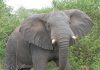
Many trees depend on the elephants’ digestive system for their seeds to be effectively propagated and if elephants become extinct, such trees would be prone to extinction. When the forest elephants eat the fruits of certain trees, they break the dormancy of the seeds and when they are excreted, the dispersed seeds germinate and sprout from the dung, giving hope for to combat climate change.
These are some of the revelations made on Monday by conservation experts at one of their community sensitisation programmes on the need to protect elephants in what is left of their natural home range in Nigeria.
The experts, from the Nigerian Conservation Foundation’s Forest Elephant Initiative and Rufford Foundation’s Elephant Conservation and Awareness Project, pointed out that the animals’ intelligence enables them to remember previous encounters with humans and to determine a course of action.
Speaking at Atikiriji Odo, a community in the boundary area of Omo Forest, Ogun State, Dr. Tajudeen Amusa, from the Department of Forest Resources Management, University of Ilorin, helped the community to appreciate the importance of the forest, the role of wildlife, especially forest elephants in maintaining the health of forest and how to live in peaceful coexistence with nature.
Dr. Amusa who has studied elephants throughout Nigeria for more than seven years highlighted the consequences of encroaching into the elephants’ territories, reminding the community that it is a criminal offence to kill elephants since they are protected by both local and international laws.
“The forest elephant is vulnerable to extinction and so, it is hard to kill it and escape dire consequences and punishment from the government,” he said.
He added that planting red pepper around their crops will help protect it from raiding by elephants.
Responding, Baale Atikiriji Odo, Afisu Busari, the Community leader thanked the experts for the initiative. He expressed appreciation to the team for travelling through difficult terrain to reach them with the crucial information and urged them to keep the good work up. The outreach was supported by Nigeria Conservation Foundation (NCF), Wild Planet Trust, Elephant Crisis Fund, Rufford Foundation among others.
According to recent estimates, there are less than 1000 individuals elephants of two different species — the forest elephant and the savannah elephants — in Nigeria. About 350 savannah elephants reside in the Yankari Game Reserve, while a viable population of less than 100 forest elephants reside in Omo Forest Reserve. Others are found in Kamuku Park, Okomu National Park and Osse River Park.
Unity Bank says it is in partnership with Avant-Garde Innovation and Technology Services (AGITS) to deepen advocacy initiatives for stronger climate action that will entrench values and ethos for achieving Sustainable Development Goals in the country.
A statement by the bank on Wednesday quoted Mrs Tomi Somefun, Managing Director, Unity Bank Plc, as stating this in Lagos at a roundtable discourse with the theme: “The Future of Sustainable Development in Nigeria: Achieving Economic Growth with Low Carbon Trajectory in a Circular Economy.”
Somefun said that the discourse provided the platform for stakeholders to evaluate developmental activities impacting on climate change and opportunities in a green economy as a means of improving environmental sustainability.
She said that a green economy would address global warming, rising sea levels, pollution, desertification and deforestation, and determine effective response to promote community action, protect the environment and advance sustainable development.
Somefun, represented by Usman Abdulqadir, Executive Director, Risk Management and Compliance, stressed the need for increased stakeholder engagement on sustainable development to deepen commitments towards promoting climate change initiatives.
“It is the hope that while sharing experiences on actions to protect the earth for future generations, the platform is capable of harnessing ideas to forge common action points and convergence for policy makers, entrepreneurs, sustainable development experts and other organisations playing pivotal roles to solve problems threatening the sustainability of the planet earth.
“Having promoted sustainable practices in agriculture over the years, and its commitment to sustainability, Unity Bank appreciates the need to create more awareness, engagement and collaboration in the execution of sustainability initiatives, thus the roundtable is not only relevant but timely,” she said.
Somefun recalled that in 2018, Unity Bank won the Central Bank of Nigeria (CBN) award on ‘Sustainable Transaction of the Year in Agriculture’ in recognition of the bank’s initiatives to promote sustainability initiatives and impact in the agricultural space
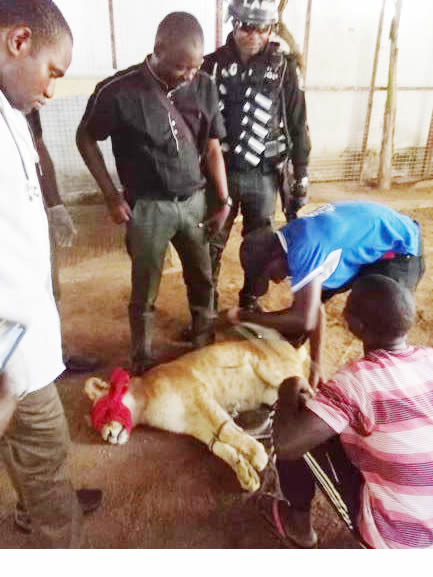
A lion that was used as a ‘security guard’ has been removed from outside an apartment block opposite a crèche and primary school.
A task force intervened to take the two-year-old lion, named Kiara away from the Lagos property on Friday.
The owner, said to be an Indian expatriate has been urged to turn himself in to police or he could be arrested.
The lion, who was thought to have been brought to the building, 229, Muri Okinola, Victoria Island, two months ago was transported after being tranquilized, to Bogije Omu zoo, Lekki.
Lagos State Environmental Sanitation and Special Offences Unit workers found the animal after a petition by people who live in the area was sent to the ministry of environment. The school said it was worried about the safety of the children.
Meanwhile, three people have been arrested in connection with the illegal possession of the big cat. In an exclusive chat with Channels Television, Chairman of the Lagos State Taskforce on Environment and special offences, Olayinka Egbeyemi, explained that the three retired officers, who double as security officers to the cat owner, said they were aware of the presence of Kiara, the lion within the building since it arrived.
Lions are found in two places in Nigeria, Yankari Game Reserve – where there are about five – and Kainji Lake National Park, where about 30 of the big cats live.
Suleiman Saidu, a Nigeria senior game guard ranger from Yankari National Park was honoured at the 2019 African Rangers Award in Accra on Friday.
Saidu was honoured along with 49 other rangers working in 17 countries across Africa. Six rangers were recognised posthumously after they died in the line of duty.
This is the second annual Awards, which will be given annually for 10 years by the Paradise International Foundation, a Chinese not-for-profit environmental conservation organisation, and the Alibaba Foundation, a charitable organisation established by Alibaba Group.
The Paradise International Foundation was set up by Jack Ma and other Chinese entrepreneurs, artists and philanthropists. It works to preserve the planet through charitable actions, a scientific approach, and efficient business management.
“The difference between us and you is that we protect ourselves first then we talk about protecting the Earth,” Ma said.
Mirriam Namushi is one of Africa’s growing number of women rangers, and one of the few to reach a very senior position — Area Warden — at one of the continent’s largest conservation areas, the 22,400 sq. km Kafue National Park in Zambia.
“Rangers face danger to protect wildlife; you are different. You are the real heroes.
“Today there are only two places most kids go to see animals: zoos, to see animals in cages, and museums, to see animals that are already lost.
“I hope that in the future our kids don’t only know animals through books. Protecting animals is not just the responsibility of rangers, it’s the responsibility of everyone.”
Clare Akamanzi, Executive Director and CEO of the Rwanda Development Board; M. Sanjayan, CEO of Conservation International; and Fred Swaniker, Founder and CEO of African Leadership Group, attended and addressed the event.
Dozens of nominees from 17 countries were suggested by colleagues, employers, government agencies, or tourism partners. A panel of conservation leaders including Irene Amoke, Executive Director of the Kenya Wildlife Trust; Dr Max Graham, CEO of Space for Giants; and Matthew A. Brown, Africa Director of The Nature Conservancy, selected the winning list.
Many of the winners have been injured or faced significant danger in confrontations with wildlife criminals. Each received a $3,000 cash prize, given to family in the cases of fallen rangers.
Four in five African rangers had faced mortal danger at work, and three in five had been directly attacked by poachers, a 2016 survey found. More than 1,000 lost their lives protecting wildlife and wild habitats between 2000 and 2016.
“To be a park ranger is a dangerous job but we can’t leave our wild animals without protection because it can cause the extinction of all animals all over the world,” said Leonidas Mpumuje, Head Rhino Monitor working with African Parks at Akagera National Park in Rwanda, and one of the winners.
Mirriam Namushi is one of Africa’s growing number of women rangers, and one of the few to reach a very senior position — Area Warden — at one of the continent’s largest conservation areas, the 22,400 sq. km Kafue National Park in Zambia.
“We women are few in conservation at the moment, but the few that we are, I think we are doing a better job than men,” Namushi said.
“We take the job more seriously, and when it comes to corruption, there is less. We are more dedicated to our work.”
Lijun Sun, Partner of Alibaba Group and Chairman of the Alibaba Foundation, said that protecting Earth’s natural resources is one of Alibaba Foundation’s core missions.
“Alibaba leverages its technologies and experience in creating impact through public engagement such as the Ant Forest app, to lead efforts in environmental protection and conservation,” he said.
“Alibaba is willing to work with responsible companies and environmentalists to take advantage of their respective platforms and technologies to jointly resist illegal poaching, promote public awareness of environmental protection, and empower environmental protection.”
The Paradise International Foundation and Alibaba Foundation are sponsoring in full both the cash rewards for the rangers and the programme’s management expenses for the next 10 years, expected to be $1.5 million in total.
“The challenges to protected areas are changing and increasing and there has never been more of a need for park rangers,” said Shawn Zhang, CEO of the Paradise International Foundation.
“They are soldiers fighting courageously with insufficient support, they lack basic supplies like boots, socks, tents and GPS. They are husbands and wives and parents, they are heroes risking their lives for conservation.”
Africa is home to the richest diversity of wildlife in the world, including more than 1,000 species of mammals, 500 kinds of birds and 2,000 types of freshwater fish. Poverty, bushmeat hunting, the illegal wildlife trade pose serious threats to the continent’s bio-sustainability.
Five hundred rangers will be recognised through the 10-year programme. The Foundation hopes that the African Ranger Awards will continue to raise public awareness of the importance of safeguarding Africa’s diverse wildlife and creating sustainable development.